Founded in New York in 1954 as the Spanish Institute by a group of Americans with a profound interest in Hispanic culture, the Institute’s mission is to stimulate interest in the United States in the culture, art, language, literature, history, and way of life of Spanish-speaking countries, while promoting mutual knowledge and understanding.
Her Majesty Queen Sofía became the Patroness of Honor of the Spanish Institute in 2003, and the organization was renamed the Queen Sofía Spanish Institute (QSSI). Her Majesty has maintained a very active, dedicated commitment to the Institute’s mission.
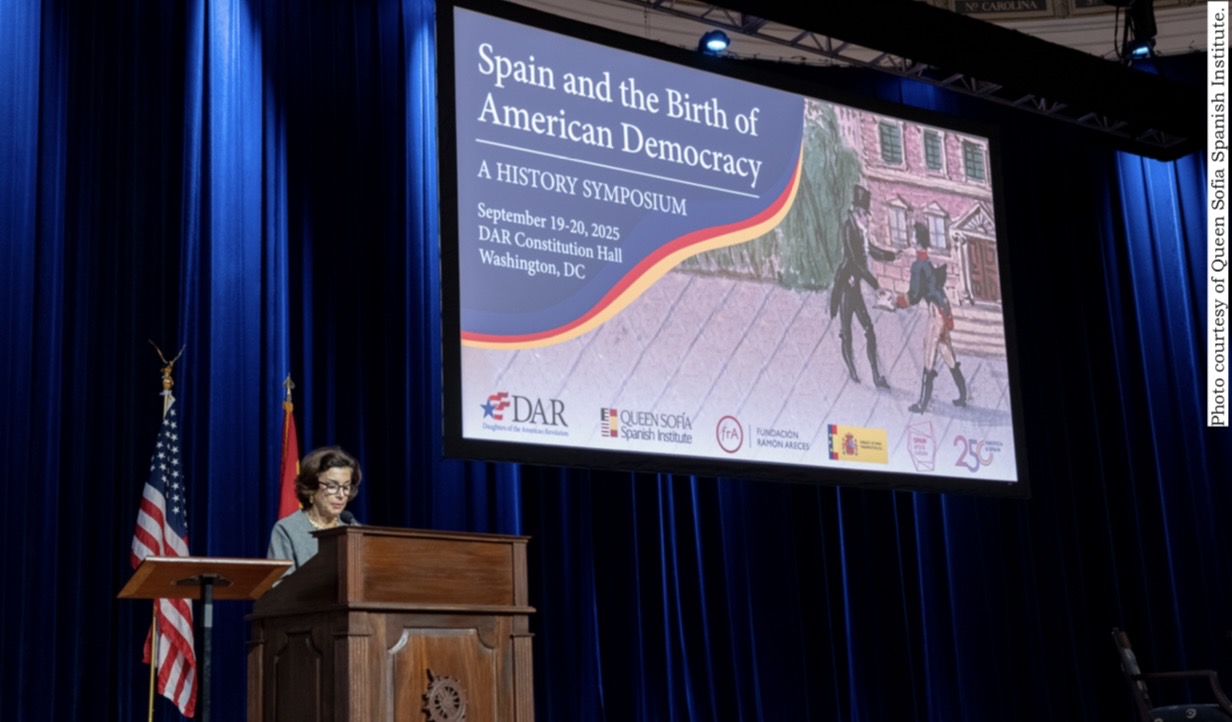
QSSI’s mission is particularly visible today through the America&Spain250 Initiative launched by the QSSI on July 4, 2023, in anticipation of the 250th anniversary of the United States. Beginning with Spain's fundamental— yet little understood—role in the American Revolution, the initiative seeks to place the Spanish and Hispanic contribution within the broader narrative of the nation's founding.
The anniversary provides an extraordinary opportunity, but the Institute’s objective goes well beyond a commemoration. The QSSI wants to use this moment of national attention to help create a more complete understanding of American history, one in which the Hispanic presence is not treated as something peripheral or recent, but recognized as part of the country's historical foundation.
Her Majesty Queen Sofía is also the Patroness of Honor of the QSSI’s America&Spain250 Initiative. Her presence at key events in the rich initiative´s programming has brought enormous visibility and enhanced the impact of the Initiative’s mission.
The America&Spain250 initiative has likewise received support from respected institutions and foundations, including Fundación Reina Sofía and Fundación Ramón Areces, helping to strengthen the reach of its educational and cultural programs. It has entered into partnerships with many of the most prestigious public and private institutions in Spain and the United States, including the Spanish Embassy and consulates in the U.S., America250, the DAR, the Society of the Cincinnati, the New Orleans Historic Collection, and the Hispanic Society Museum and Library.
The Institute pursues its overall mission across several areas, including education, history, language and literature, visual arts, science, gastronomy, and performing arts. Through lectures, symposia, exhibitions, performances, educational resources, awards, and partnerships with academic and cultural institutions, we create different points of entry into the Spanish-speaking world. Education, however, has become an especially important part of our work because it offers the possibility of creating knowledge that lasts beyond an individual event or anniversary.
One of the QSSI’s most important educational partnerships is with the Gilder Lehrman Institute of American History, together with Spain's Real Academia de la Historia. Through this collaboration, the partners developed Spanish Influence on American History, an educational platform that provides teachers and students with maps, biographies, timelines, translated primary sources, videos, academic materials, and complete lesson units for grades 7 through 12.
This platform aims to provide teachers with rigorous, classroom-ready resources that allow them to enrich the content they already teach. The American Revolution, for example, can be understood not simply as an isolated conflict between the thirteen colonies and Great Britain, but as part of a much broader international conflict involving Britain, France, Spain, and other powers across North America, Europe, and the Caribbean. This broader approach gives students greater context and encourages them to think globally and develop critical-thinking skills.
The scale of the partnership makes this particularly meaningful. Gilder Lehrman reaches more than 37,000 schools in the United States and beyond. This collaboration facilitates the efficient distribution of information about the Spanish contribution to the history and culture of the United States and moves this knowledge beyond universities, archives, and specialized historical circles into classrooms across the country.
The QSSI has also sought ways to help students become active participants in discovering this shared history. The Quizstory Podcast Award is a particularly good example. After three editions in Spain, the QSSI launched the competition in the United States for the first time in 2026. Students research figures and episodes from the shared history of Spain and the United States during the American Revolution and transform that research into original podcasts. In doing so, they combine historical investigation with critical thinking, storytelling, and communication skills. More than 200 students participated in the third edition in Spain, while the first U.S. edition extended the project to American students in all states.
The Institute’s commitment to education also includes creating opportunities for students to continue that intellectual exploration at the university level. Beginning in the 2026–2027 academic year, the Queen Sofía Spanish Institute–IE Foundation Scholarship provides 50 percent tuition coverage for the duration of the degree to outstanding candidates pursuing a Bachelor in Humanities or a Dual Degree in Business Administration and Humanities at IE University. Developed within the framework of the America&Spain250 Initiative, the scholarship supports U.S. students and residents interested in exploring the cultural and historical connections between the United States, Spain, and the Spanish-speaking world.
Alongside education, the Institute also recognizes individuals whose work exemplifies its wider mission. TheSofia Award for Excellence, our most prestigious distinction, recognizes individuals or organizations that have contributed to the international appreciation of Spain and the Americas through their time, expertise, and wisdom in the sciences, arts, or humanities. Past honorees include figures such as Jorge Pérez, Frank Rainieri, Gustavo Dudamel, Gloria and Emilio Estefan, José Andrés, and Carlos Slim, reflecting the breadth and diversity of the Hispanic world. The award seeks to identify and celebrate leaders throughout the United States, Latin America, Spain, and the wider Spanish-speaking community whose work strengthens understanding across cultures.
When Americans discover the role played by figures such as Bernardo de Gálvez, Juan de Miralles, Diego de Gardoqui, or Francisco de Saavedra in the era of the American Revolution, they are not learning someone else's history. They are recovering part of their own. The same is true for millions of Hispanic Americans whose connection to the history of the United States is much older and deeper than is sometimes assumed.
As I recently reflected, my hope is that, by the time the United States celebrates its 300th anniversary in 2076, figures such as Bernardo de Gálvez, Juan de Miralles, Diego de Gardoqui, and Francisco de Saavedra will have become part of the collective consciousness of the United States.
More broadly, the QSSI seeks to help Hispanic Americans recognize that their history in this country is not a recent addition to the American story but is deeply connected to the country’s origins. Through education, historical research, and public programming, the QSSI hopes to contribute to making that history better known and more fully integrated into how Americans understand their own past.
We invite readers to stay connected with the Queen Sofía Spanish Institute, explore our educational and cultural programs, and follow our work as we continue building bridges between the United States, Spain, and the Spanish-speaking world.
https://queensofiaspanishinstitute.org/
https://americaspain250.org/
https://www.instagram.com/qssi_ny/
About the author
Begonia M. Santos is the president and CEO of the Queen Sofia Spanish Institute in New York City.